
Fake World Cup Ticket Sites Target Fans: What Businesses and Consumers Can Learn
As anticipation builds ahead of the 2026 FIFA World Cup, cybercriminals are already preparing their own game plan.
2 min read
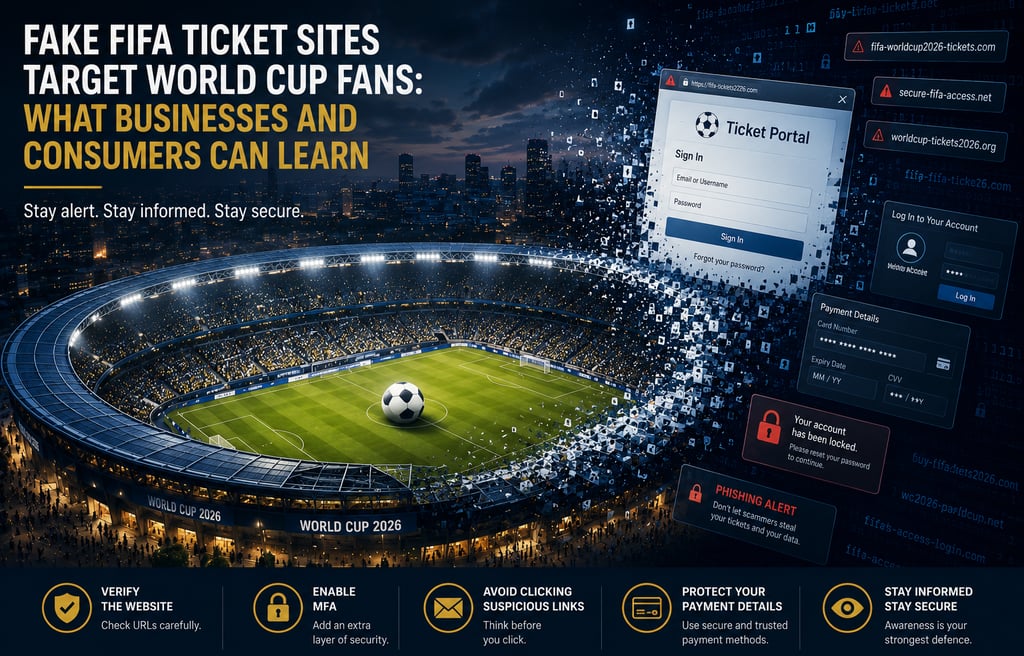
Researchers at Group-IB have identified a large-scale fraud operation known as GHOST STADIUM, a criminal network that has reportedly created more than 300 fake World Cup ticketing websites across thousands of domains. The objective is simple: steal login credentials, payment details, and in some cases gain access to legitimate ticket accounts.
While football fans may be the immediate target, the techniques being used should be familiar to every organisation.
How the Scam Works
The fraudulent websites closely imitate legitimate ticket purchasing platforms.
Victims are directed to professional-looking websites that appear genuine and are encouraged to log in or complete ticket purchases. Once credentials and payment details are entered, the information is captured by the attackers.
In some reported cases, victims are redirected to legitimate websites afterwards, creating the impression that everything worked normally.
Researchers have also warned that some of the infrastructure can be used to trigger password resets, potentially locking victims out of their accounts while criminals gain access and attempt to resell legitimate tickets.
Why This Matters Beyond Football
At first glance, this looks like a consumer scam.
In reality, it demonstrates one of the most effective cyberattack techniques still used against organisations worldwide: phishing through trusted brands.
The attack relies on three things:
1. Trust in a recognised brand
2. A sense of urgency
3. A convincing imitation
Whether the target is a football fan, an employee, or a business owner, the psychology remains the same.
The technology changes. Human nature doesn't.
The Same Tactics Used Against Businesses
Every day, organisations face attacks involving:
- Fake Microsoft 365 login portals
- Supplier impersonation scams
- Fraudulent invoice requests
- Fake IT support messages
- Business email compromise attempts
In most cases, attackers are not exploiting technical vulnerabilities.
They are exploiting trust.
This is why phishing remains one of the most successful attack methods despite significant advances in security technology.
Warning Signs to Watch For
Whether purchasing event tickets or accessing business systems, users should be cautious if they notice:
- Unexpected emails or messages containing links
- Website addresses that differ slightly from official domains
- Pressure to act quickly due to limited availability
- Login pages reached through advertisements or social media links
- Requests for credentials or payment details on unfamiliar websites
How to Protect Yourself
For Consumers
- Purchase tickets only through official channels.
- Verify website addresses before entering credentials.
- Enable Multi-Factor Authentication where available.
- Use strong, unique passwords.
- Monitor payment card activity after purchases.
For Businesses
- Deliver regular phishing awareness training.
- Implement Multi-Factor Authentication across critical systems.
- Deploy email security controls.
- Encourage staff to verify websites before entering credentials.
- Establish clear reporting procedures for suspicious emails and websites.
Final Thoughts
The GHOST STADIUM campaign is a reminder that many cyberattacks do not rely on sophisticated malware or advanced exploits.
Often, the most effective attack is simply a fake website that looks convincing enough.
As major events such as the World Cup approach, cybercriminals will continue to exploit excitement, urgency, and trust to increase their chances of success.
Whether you're buying football tickets or accessing business systems, the principle remains the same:
Verify before you trust.
If you'd like to discuss phishing resilience, security awareness training, or strengthening your organisation's cyber defences, contact CNI Security Solutions.
CNI Security Solutions
We help businesses stay secure and win more business with confidence.
info@cnisecurity.co.uk
© CNI Security Solutions Limited. 2026. All rights reserved. Company Number: 16272265 Registered in England and Wales
e-Innovation Centre | University of Wolverhampton |Telford Campus | Priorslee |Telford |TF2 9FT
Let's talk about your security
Have a security question or not sure what you need?
Prefer to send us a message?
Contact us →